5 Years Against Tech Abuse
Note: these are my personal thoughts about a collective work over several years that continues without me, so it only represents my subjective views and not Echap or other Echap members’ view or opinions. This article openly talks about intimate partner violence and tech abuse.
Six years ago, we gathered with a few friends after a tech conference and talked once again about the fact that some forms of digital surveillance and tech abuse were rarely addressed in hacker and tech activist circles. While state and corporate surveillance have been at the center of discussions for a long time, it took years of online harassment against women and LGBTQI+ people to start seeing a few discussions about these issues in tech activist groups. Don’t get me wrong, state and corporate surveillances are legitimate issues that deserve research, reporting and actions against them. But some other tech-enabled social issues are also worthy of consideration and action. Three out of five young activists face online harassment for posting about human rights, in France 82% of women survivors of intimate-partner violence have faced online harassment, 93% of them have faced some form of online control.
After long discussions over the winter, we founded the Echap non-profit in February 2020 with the objective of supporting professionals fighting against intimate-partner violence on technology. Since then, we have written and maintained guides on how to secure devices and online accounts, organized training on tech abuse for women’s shelters, organized online learning sessions and supported survivors of violence in collaboration with women’s shelters. After five years at Echap and many hours of work, I decided to leave the organization last year and effectively left during the last general assembly in March.

During these past months, I have had time to reflect on this very formative experience and thought it would be a good time to write a quick blog post about some lessons I learned during these years.
Lack of Knowledge#
During the first year at Echap, our main objective was to understand intimate-partner violence (IPV) and how tech contributed to that violence. While IPV is not a new social issue and there is a long history of research on this topic, tech enabled IPV is way more recent and hasn’t received yet much attention. For years, the only resource we had in France was the great 2018 report by the centre Hubertine Auclert. This report confirmed that there is a major issue with tech abuse in IPV, and tried to draw lines between different scenarios such as control, harassment, surveillance, economic and administrative violence and sexual violence. That was an important first step, but this report was also based on questions to survivors of violence they faced. On complex forms of technical surveillance it is often hard to find the surveillance technique used without an in depth technical analysis that few survivors had access to. Without such analysis and detailed numbers, it hard to develop technical solutions to support survivors, and there may be a gap between perception and actual form of abuse. An example of that is that 29% percent of women questioned in the study had the feeling that they were surveilled by their partner through GPS or spyware. While this provides an indication of feeling, it is hard to know precisely the technique used by the abuser.
So I spent some time looking at research in other countries (in my case limited to English speaking countries sadly), and found some really interesting research that provided some in-depth analysis of these questions, and precise descriptions of the solutions they tested to support survivors. While many organizations have been doing amazing work, I have been really inspired by the work of the Clinic to End Tech Abuse born out of Cornell research teams, their research and resources. As far as I know, they were the first to provide the data on technical assessments of survivors of tech abuse while using a methodology centered around survivors’ concerns:
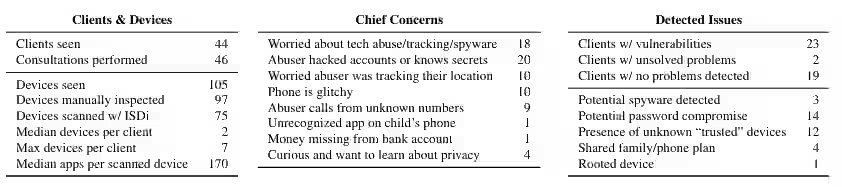
What this table seems to show is that there is generally a difference between the perceived threat scenario and the actual threat scenarios for many survivors of tech-enabled IPV. And that means we need further research to be able to understand more precisely what tools and techniques have enabled such abuse, in order to better support survivors but also design technology in a way that is not enabling these abuses.
Another difference that appeared to me over these years is the gap between topics of interest for media and the reality of tech-enabled IPV. For years, we had journalists contacting us about articles mostly on abuse of AirTags or stalkerware. While these are real issues, it is very likely that the most prevalent forms of abuse and surveillance are simpler and cheaper: abusive exes keeping access to their ex-email addresses, online harassment, publications intimate pictures on social media, or even waiting all day in front of their home (something I was able to empirically verify in our support work). These forms of abuse are rarely talked about in media, and in a sense, media articles tend to misrepresent the reality of these abuses (even if some journalists are aware of that gap and careful not to contribute to it).
Lack of Funds#
My discovery of the world of women’s shelters was also the discovery of under-funded structures and dedicated social workers (99% of them being women) going above and beyond to compensate for their lack of resources. Even when the French government decided to make the fight against domestic violence an important part of their platform in 2018 and organize an event on that topic nationally, this wasn’t supported by any increase in funding for shelters. A social worker told me that their work was even harder because the public discussions about domestic violence led more women to realize that they were victims of it, and get in touch with shelters that were overburdened and under resourced.
In 2023, the Fondation de France estimated that 2.6 billion euros were needed in France to fight against gender-based violence, while today this budget is only around 184.4 million (yes, that is 7% of what is needed).
What that meant for us at Echap was that we didn’t want to get money from funds that would otherwise go to shelters. Taking money on the budget allocated to shelters to help shelters would be counter-productive. But it was very challenging for us to successfully raise funds on other sources of funding that are usually allocated to technology issues. For instance, we received feedback that developing guides to secure Facebook accounts wasn’t promoting free software enough. Other projects that successfully received funding had a clear techno-solutionist approach that was in contradiction with our ideas.
The Right Way to Support Shelters#
After a first year developing resources and reading about cyberviolence, we quickly decided to develop training on tech abuse for social workers, and led several training for professionals working in women’s shelters or similar organizations. Our training were focused on empowering people with technology and demystifying it, so we had some very practical exercises like changing passwords, verifying what is shared by the phone etc. All this on test devices or accounts that people could openly manipulate without fearing to intrude in someone’s privacy. We had some really positive feedback on these training and I really felt it was making technology less scary for people, and they would be more comfortable supporting women they worked with.
But the reality of making change is always more challenging. While some people clearly integrated some of what they learned into their daily work, for many people (especially those not very tech-savvy) work went back to normal and they didn’t really apply these notions to support their users. And while things may appear simple for us who are working with technology every days, many aspects of technology are actually very challenging. Take an Android phone for instance : each phone is different depending on the brand, the model and the Android version. While we tried to consider different Android versions in our guides, it was impossible for us to be exhaustive on all the existing models. And they do change a lot! I remember one phone on which I couldn’t find a specific menu to check security settings. It turned out that on this model, this setting page wasn’t listed in the menu at all and was only available by searching for it in the search bar. So if you are not dealing with technology regularly and interested and curious about all these details, it is actually a lot to learn and specific skills to develop. All this while social workers already have a challenging job that requires them to have a wide variety of skills.
So some organizations turned to another model: find a tech-savvy person to regularly come work with them to support their users on technology issues. While this may seem a better option, it also creates significant challenges. The first one is to find people who are able to work with survivors of domestic violence. It requires understanding of what they are going through and the responsibility of accepting to support them. It also requires to accept to take time to explain things that may be obvious to you but aren’t. It requires to understand that these problems are not technical problems and that solutions won’t be technical. I have met many really skilled tech people who approached this problem as a technical issue to solve, often through solutions that didn’t make sense in the context of supporting survivors of IPV (just use another DNS resolver! Just move to Linux!). Then you also need to find someone who is interested in this work. Many tech people are attracted by the technical challenge and the novelty, but the reality of this work is that in most cases the focus will be to change passwords and not investigate a new complex spyware. And finally, you need to find someone who has the skills to understand these potential surveillance scenarios and help people using everyday technology. After all, as tech experts we are often using technology in a way that is very disconnected from what everyone uses (said by someone who is writing this article in VIM).
I really think that the solution lies in between these two approaches. I think all social workers should receive training on tech-enabled abuse because it will empower them to tackle this form of abuse and simple solutions like changing passwords can go a long way to help people. However, it is not realistic to ask them to become tech experts, so we need to develop places for tech-savvy people to learn about tech-abuse, and develop a structured way to support survivors in a way that is victim-centered and effective. On that again, I found the detailed methodology developed by the Clinic To End Tech Abuse a source of inspiration to develop more structures on that model.
Between Professional and Volunteer Non-profits#
Finally, I also thought about the challenge of creating and developing a non-profit organization. It was the first time I had created an organization from scratch and a fascinating learning experience, both on the administrative aspects and on the organization of the work itself. One thing I didn’t realize early enough was the need to choose a specific model between volunteer-based organizations and professional non-profits.
In volunteer-based non-profits, most of the work comes from volunteers investing their non-work time and the challenge of the organization is to structure this volunteer work to allow them to do useful and good quality work while fitting in the time they are willing to allocate to the organization. For instance, when I volunteered in a homeless shelter some years ago with Médecins du Monde, they had a very clear structure for me: one evening every two weeks, three months to test if it worked for me, then a commitment to do it for a year, and a check-in at the end of the year to see if I wanted to continue or do something else. That structure allowed to have many people joining in order to do meaningful activities at scale (not everyone has to be a volunteer, some non-profits have professional paid staff in charge of organizing the volunteer’s work).
In professional organizations, the work is done by few people who are paid to do it as a professional activity. This means that there are higher expectations in terms of workload and quality of work for this staff who is compensated for it. In most professional NGOs, the work goes from grant to grant and most of the unpaid work is spent fundraising in order to pay for the projects, and ideally grow big enough to hire a full-time fundraiser and sustain the rest of the organization.
While each of these structures have their pros and cons (and some large structure have a hybrid model), I didn’t realize that we were struggling to pick a model at Echap. On one hand, we wanted to integrate more people in the collective but without having clearly defined the tasks they could do. On the other hand, we saw the work as being mainly done by a small group with expectations of quality and workload of a professional non-profit, without the budget that goes with it. This created a lot of work and pressure on all of us, especially in a context where we felt that there was an important need among domestic violence professionals.

Some resources#
It would be too bad to finish this article without referencing useful resources on tech abuse, both to help people looking for such resources but also to thank all the people who have developed really meaningful resources that have been of tremendous help in my work at Echap.
- The Clinic to End Tech Abuse, its research, its resources and its toolkit
- Technology Safety Australia
- Tech Safety Canada
- Do-It-Yourself Online Safety by Chayn
- DeStalk
In French:
- Echap resources of course
- The Centre Hubertine Auclert and their guide de protection numérique
- Féministes contre le cyberharcèlement
- Guides “Nos voix, nos combats”